

What Is TENGENCE Cloud? A Full Picture of Its Products and Core Capabilities
Introduction
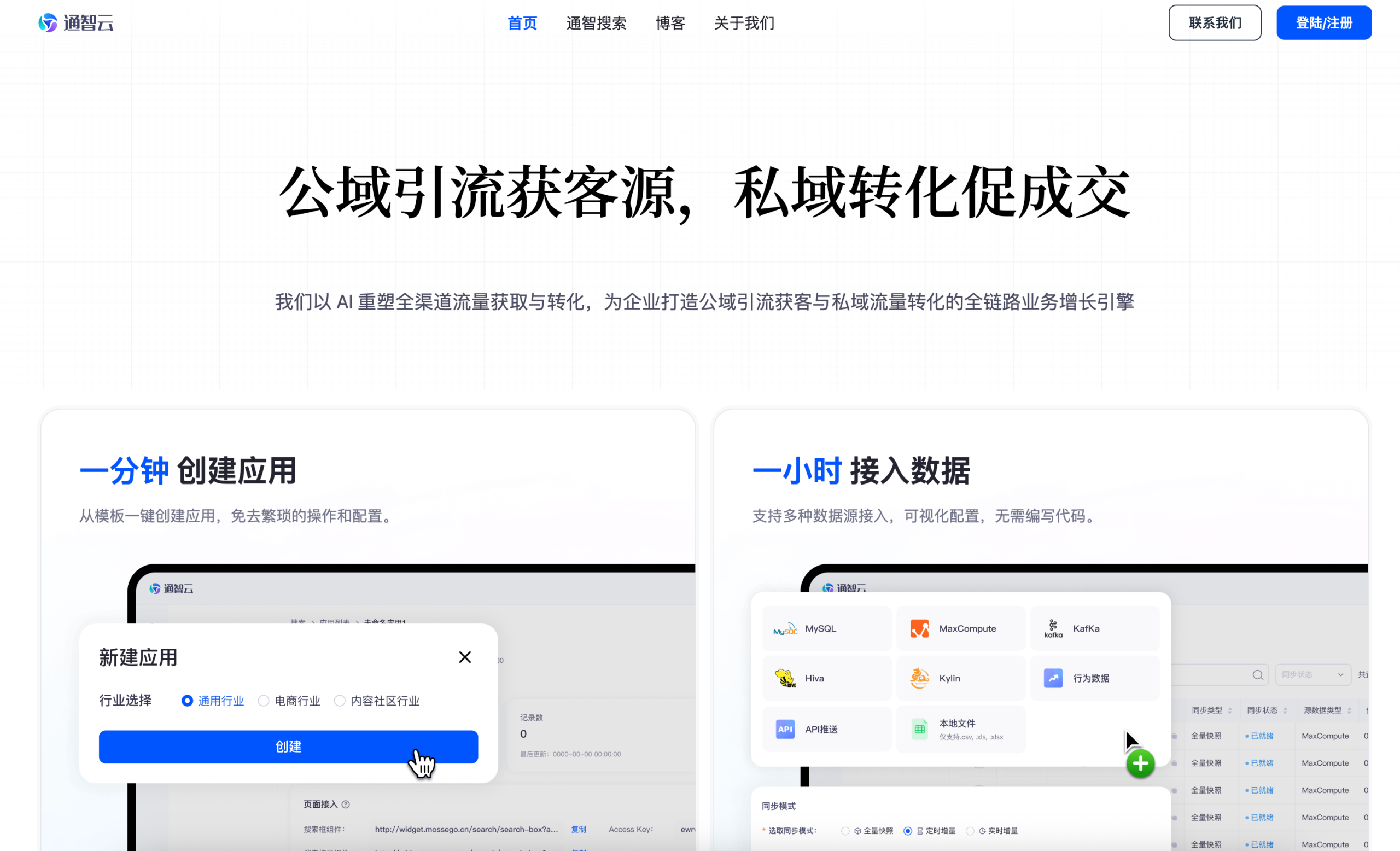
TENGENCE Cloud is an AI-driven enterprise growth engine positioned as "public-domain traffic acquisition at the source · private-domain conversion that drives deals." It currently offers two products — TENGENCE GEO and TENGENCE Search. The former uses a GEO + SEO dual engine to help Chinese export-oriented businesses and standalone sites build brand visibility simultaneously across search engines such as Google and Bing and AI engines such as ChatGPT, Perplexity, and Claude; the latter solves the conversion problem of on-site search and intent understanding.
1. Definition and Positioning of TENGENCE Cloud
TENGENCE Cloud's positioning breaks into two halves:
- Public-domain traffic acquisition at the source: get businesses found and cited in search engines and AI search, turning public-domain traffic into identifiable visitors.
- Private-domain conversion that drives deals: help visitors find the content and products they want faster on the business's own site, mini-program, or app, turning visitors into leads and orders.
These two halves correspond to two different products, not two modules of one product. Understanding this is the prerequisite to understanding the TENGENCE Cloud product line.
1.1 Why focus on these two things
There is only one reason: users' information-seeking behavior is migrating from the "search box" to the "dialog box."
Globally, a survey by digital marketing research firm DataReportal in Q4 2025 shows that 81% of internet users aged 16 and above now use AI tools regularly, and the most common use case is "finding information" (58.8%); Gartner predicts that by 2026 traditional search-engine query volume will drop by 25%, with market share flowing to AI chatbots and other virtual agents.
China's market is moving in sync. According to the 55th Statistical Report on Internet Development in China released by the China Internet Network Information Center (CNNIC) in 2025-01 (data as of 2024-12), the number of generative-AI product users in China has reached 249,000,000, accounting for 17.7% of the national population; among these users, 77.6% primarily use it to "answer questions."
| Metric | Value | Scope & Source |
|---|---|---|
| Share of netizens using AI tools regularly | 81% | Global internet users aged 16+ (DataReportal, Q4 2025) |
| Share of AI users who "find information" | 58.8% | Global AI users (DataReportal, Q4 2025) |
| Projected change in traditional search volume | −25% by 2026 | Global (Gartner, 2024-02) |
| Generative-AI product user base | 249,000,000 | China market, 17.7% of population (CNNIC 55th report, 2025-01) |
| Share of generative-AI users who "answer questions" | 77.6% | China market (CNNIC 55th report, 2025-01) |
Both datasets point in the same direction: the entry point for users to obtain information is migrating from the "search box" to the "dialog box." This migration line triggers two things at once:
- In the public domain, some "searches" become "questions" — businesses need to appear in AI's answers, not just in the results pages. This is where TENGENCE GEO comes from.
- In the private domain, users enter the site with higher expectations; if they cannot find what they want on-site, they bounce faster — which further amplifies the value of TENGENCE Search.
TENGENCE Cloud's product boundary is drawn exactly along this migration line.
2. Product Composition
TENGENCE Cloud currently has exactly two products.
| Product | Problem solved | Use cases | Core capabilities |
|---|---|---|---|
| TENGENCE GEO | Export businesses lack visibility, struggle to measure it, and get misattributed across Google, Bing and other search engines and ChatGPT, Perplexity, Claude and other AI engines | Chinese export businesses, standalone sites (DTC cross-border e-commerce / export B2B SaaS / export brand owners / multi-region service providers) | GEO + SEO dual-engine synergy, AI-visibility insight, global multilingual, AI content automation, measurable outcomes, white-box tuning |
| TENGENCE Search | Poor on-site search relevance, high zero-result rate, search that does not convert | E-commerce, content platforms, enterprise knowledge bases, SaaS back offices | Semantic retrieval, query understanding and correction, suggestion terms, relevance ranking, search API integration |
The relationship between the two is complementary, not substitutive: TENGENCE GEO acts on the business's external public domain, while TENGENCE Search acts on its own private domain. One "brings people in," the other "keeps them."
2.1 TENGENCE GEO
Built for the search and AI-asking scenarios of export businesses. When users ask questions on search engines such as Google and Bing, as well as AI engines such as ChatGPT, Perplexity, and Claude, TENGENCE GEO helps businesses answer three questions:
- Does my brand appear in these answers? (visibility monitoring)
- Is the position and wording accurate? (citation and attribution analysis)
- What content should I change to be cited? (targeted optimization suggestions)
The answer to question 3 is typically organized with the CITE framework: C for Content authority (add verifiable data and sources), I for Information structure (lead with conclusions, self-contained paragraphs), T for Technical accessibility (crawler allowance and structured markup), E for Entity building (unified external wording for brand and product names). The four dimensions are multiplicative — missing any one diminishes the return on the other three. For the full framework, see What Is GEO (Generative Engine Optimization); for the specifics of the technical-accessibility dimension, see Technical Principles of GEO.
Why multi-source coverage is needed
The answers given by generative engines typically synthesize multiple sources: beyond the official website, they also cite encyclopedia entries, Q&A communities, industry media, and public-data pages. When brand information exists in only a single channel, the engine cannot find a second cross-verifiable source on the same topic, limiting both the probability of being cited and the accuracy of attribution. Keeping multi-channel wording consistent is the asset that can be reused long term.
Four core capabilities
- AI-search visibility monitoring: periodically ask a fixed set of questions on mainstream AI platforms, recording whether the brand appears, where in the answer it appears, and whether the wording is accurate.
- Citation and attribution analysis: distinguish between being "mentioned" and being "cited as a source," and judge which conclusions the answer attributes to the brand.
- Source-intelligence analysis: locate which sources the engine actually trusts when answering the topic, and identify high-influence source gaps that are not yet occupied.
- Content-citation optimization: provide per-article rework suggestions along the four CITE dimensions — add verifiable data and sources, lead with conclusions, apply structured markup, and unify external wording.
All four capabilities land on content and sources — TENGENCE GEO has integrated SEO into a GEO + SEO dual engine, covering both AI-citation optimization and traditional search-ranking optimization.
2.2 TENGENCE Search
Built for a business's own retrieval scenarios. It handles the process of finding content, products, and documents after the user has already entered the site.
On-site search occupies a special position in the conversion funnel: this is the first time the user actively states what they want. They are not browsing, not hesitating — they directly type their need. The behavior with the clearest intent appears on-site, which means this is both the highest-conversion position and the most costly position for churn.
Why search directly determines transaction volume
Google Cloud commissioned Harris Poll for a study (conducted in the 6th–7th months of 2021, covering 9,096 consumers across 9 countries, plus 1,004 U.S. consumers and 201 retail-site managers):
| Finding | Value |
|---|---|
| Annual loss to U.S. retailers from search failure | Over $333,000,000,000 |
| Consumers who buy additional items after finding the desired product | 53% |
| Global consumers who received irrelevant search results in the past six months | 94% |
| Global consumers who change their view of a brand after a frustrating search | 85% |
Reading this table yields one conclusion: search failure is not "one fewer click" — it simultaneously loses the order, the user, and the brand impression. 94% have encountered irrelevant results, showing this is not an occasional problem on individual sites but an industry-wide state — which is exactly why it is a high-ROI improvement area.
The reverse is also true: after search is done right, the gains go beyond "being findable." 53% of consumers buy other items on impulse after finding the target product, meaning the search-results page itself is a recommendation opportunity — with sensible ranking, both average order value and transaction volume rise together.
From "findable" to "want to buy": recommendations in ranking
Search solves "findable," recommendations solve "want to buy."
McKinsey's 2013 research estimated that about 35% of Amazon's purchases and about 75% of Netflix's viewing time come from personalized recommendations. These results are not achieved by putting the most popular items first, but by ranking per person — the same query yields a different order for different users.
TENGENCE Search builds this into its ranking strategy: combining user identification and tags, it folds browsing history, purchase records, and real-time behavior into ranking weights. When a user searches "dress," they see not a static best-seller list but a result list reordered by their personal preferences.
For the business, two layers of benefit occur simultaneously:
- Higher click-through rate: results ordered to match intent, so users click the products they actually want faster — the search-results-page CTR directly reflects this layer.
- Higher transaction volume: shifting from "give users the products they searched for" to "give users the products they are most likely to buy," conversion rate and average order value move together.
Four core capabilities
- Query understanding and correction: handle typos, synonyms, and colloquial expressions. One spelling mistake should not send a high-intent user away empty-handed.
- Semantic retrieval: combine keyword matching with vector recall to raise the hit rate on long-tail queries and directly suppress the zero-result rate.
- Relevance ranking: adjust recall and ranking strategy by business goal — conversion history, inventory, and margin can all enter the weights; layered with user identification and tags, the same query can yield different orders per person, not just "text relevance."
- Suggestion terms and filtering: lower input cost and offer candidates when the user has not yet figured out what they want — this is both an experience improvement and a natural entry point for recommendation slots.
For concrete implementation, search-experience improvement usually starts from the two metrics of zero-result rate and click-through rate; see 5 Key Points for On-Site Search Optimization for the approach.
The reason on-site search has high ROI is that it improves the conversion efficiency of the people who have already entered the site: no more traffic is needed, only making those who have already stated their need find faster and want to buy more. Both CTR and transaction volume benefit, and both map directly to revenue.
3. Typical Use Cases
| Scenario | Primary product | Expected outcome |
|---|---|---|
| B2B business wants to be recommended by AI as a new option | TENGENCE GEO | Brand and correct wording appear in industry selection-type questions |
| E-commerce site with low on-site search conversion | TENGENCE Search | Zero-result rate drops, search-session conversion rises |
| Content platform where long-tail queries cannot be found | TENGENCE Search | Semantic recall covers more colloquial queries |
| Enterprise knowledge-base document retrieval is difficult | TENGENCE Search | Supports natural-language questions, reduces ineffective searches |
| Brand misattributed in AI answers | TENGENCE GEO | Unified external wording, corrected misattribution |
4. Delivery Model
The two TENGENCE Cloud products have different delivery forms:
- TENGENCE GEO: delivered as service + tooling. Includes visibility diagnosis, content-rework suggestions, ongoing content production, plus periodic monitoring reports and human support throughout.
- TENGENCE Search: supports multiple delivery forms — cloud service + direct API integration, private deployment, and custom development for special business needs.
Different delivery forms have slightly different onboarding and tuning cycles, typically including: requirements alignment → data integration → strategy configuration → launch testing → effectiveness review.
5. Common Misconceptions
Misconception 1: GEO and SEO are an either/or choice.
Reality: both share the same body of content and the same technical foundation — a crawlable, indexable site, clear information hierarchy, and complete structured data; these are prerequisites for search indexing and also for AI answer extraction. What GEO additionally needs is only three things: conclusion-first paragraph rewrites, verifiable-data supplementation, and ongoing citation monitoring. Treating them as opposing options is the most common misunderstanding; for their division of labor and synergy, see Differences Between GEO and SEO.
Misconception 2: Buying GEO means AI will definitely cite you.
Reality: generative engines are black-box systems that iterate continuously; no organization can guarantee citation outcomes. What the product delivers is monitoring, diagnosis, and optimization suggestions, plus observable process metrics.
Misconception 3: Stuffing keywords and lengthening the article makes AI more likely to cite you.
Reality: the conclusion supported by controlled experiments is the opposite. The GEO study by Aggarwal et al. (2023, arXiv:2311.09735) compared multiple content-rewrite strategies; approaches such as "add citation sources, include statistics, present authoritative wording" significantly raised the probability of being cited by generative engines, while simply piling up keywords or simply increasing length hardly helped visibility and in some cases even went negative. Generative engines extract structurally clear, verifiable facts, not high-frequency repeated words.
Misconception 4: On-site search is just a small feature, not worth dedicated investment.
Reality: on-site search is one of the behaviors with the clearest user intent; search-session conversion is typically significantly higher than ordinary browsing. Improvements in the zero-result rate and relevance ranking are directly reflected in transactions.
Misconception 5: TENGENCE Search is just adding a search box to the official site.
Reality: the search box is only the interaction layer; the engineering effort is beneath it — data integration and index building, retrieval and ranking strategy, zero-result governance, and search-behavior analytics. These determine whether users can find what they want, whether the result order is reasonable, and whether search traffic ultimately converts to transactions.
Misconception 6: AI-citation status cannot be measured, only judged by feel.
Reality: observable proxy metrics can be built — citation rate of a fixed question set across multiple AI platforms, brand-mention rate, frequency of the brand's own data appearing in answers, and the session quality of AI-referred traffic. There is no unified industry standard for absolute values yet, so you should focus on the trend of your own baseline rather than a single absolute number.
6. Summary
TENGENCE Cloud's structure can be summed up in one sentence: two products — one guards the public-domain entrance, the other guards the private-domain exit: one is responsible for being found, the other for being converted.
If you are unsure where to start, self-check with these two questions:
- When users ask AI, will they mention your brand? If not, look at TENGENCE GEO.
- After users enter your site, can they quickly find what they want? If not, look at TENGENCE Search.
FAQ
Q: What company sizes is Tengence Cloud suited for?
A: There's a fitting version for everyone from personal sites and startups to large enterprise groups. If content-driven acquisition is your priority, start with Tengence GEO; if on-site search volume is large, start with Tengence Search. The two products can also be deployed independently.
Q: Can Tengence GEO and Tengence Search be purchased separately?
A: Yes. They address different problems and can be deployed independently. Companies under heavy public-domain acquisition pressure usually start with Tengence GEO; those with clear on-site conversion bottlenecks usually start with Tengence Search.
Q: Does Tengence Search require me to prepare servers?
A: Not for the cloud service with API access — indexing and retrieval are carried by the platform. Private deployment or customized projects require servers and a deployment environment per the solution plan.
Q: How is data security ensured?
A: Business data enters the platform via API push or database synchronization, used to build indexes and effect analysis. Data scope, retention period, and permission configuration are agreed with your enterprise during onboarding.
Q: How soon can results be seen?
A: Tengence Search goes live once integration and configuration are complete, with effects observable in weeks. Tengence GEO depends on AI engine updates; from retrofit to citation-rate change usually takes weeks to months, so establish a monitoring baseline first.
Q: Do I have to choose between GEO and SEO?
A: No. Both share the same content and technical foundation; GEO additionally requires conclusions-first rewrites, verifiable data, and citation monitoring. Treating them as opposites is the most common misunderstanding.
About TENGENCE
TENGENCE Cloud (TENGENCE) is an AI-era enterprise growth engine focused on public-domain traffic acquisition and private-domain conversion; its core products are TENGENCE GEO (GEO + SEO dual engine) and TENGENCE Search.
Related Reading
- TENGENCE GEO Optimization: Capture the AI-Search Traffic Dividend
- TENGENCE Search Optimization: 5 Key Points to Improve On-Site Search Experience
- TENGENCE Search User Guide: From Creating an App to Integrating Business Systems
Data Sources
- DataReportal "Digital 2026 Global Overview Report" (Q4 2025 survey data)
- Gartner "Gartner Predicts Search Engine Volume Will Drop 25% by 2026" (2024-02-19)
- CNNIC 55th Statistical Report on Internet Development in China (2025-01)
- Aggarwal et al. "GEO: Generative Engine Optimization" arXiv:2311.09735 (2023)
- Google Cloud "Search Abandonment" study (Harris Poll, 2021-07)
- Ian MacKenzie, Chris Meyer, Steve Noble "How retailers can keep up with consumers" McKinsey & Company (2013-10)
Get Started

